The Emblem Shelf
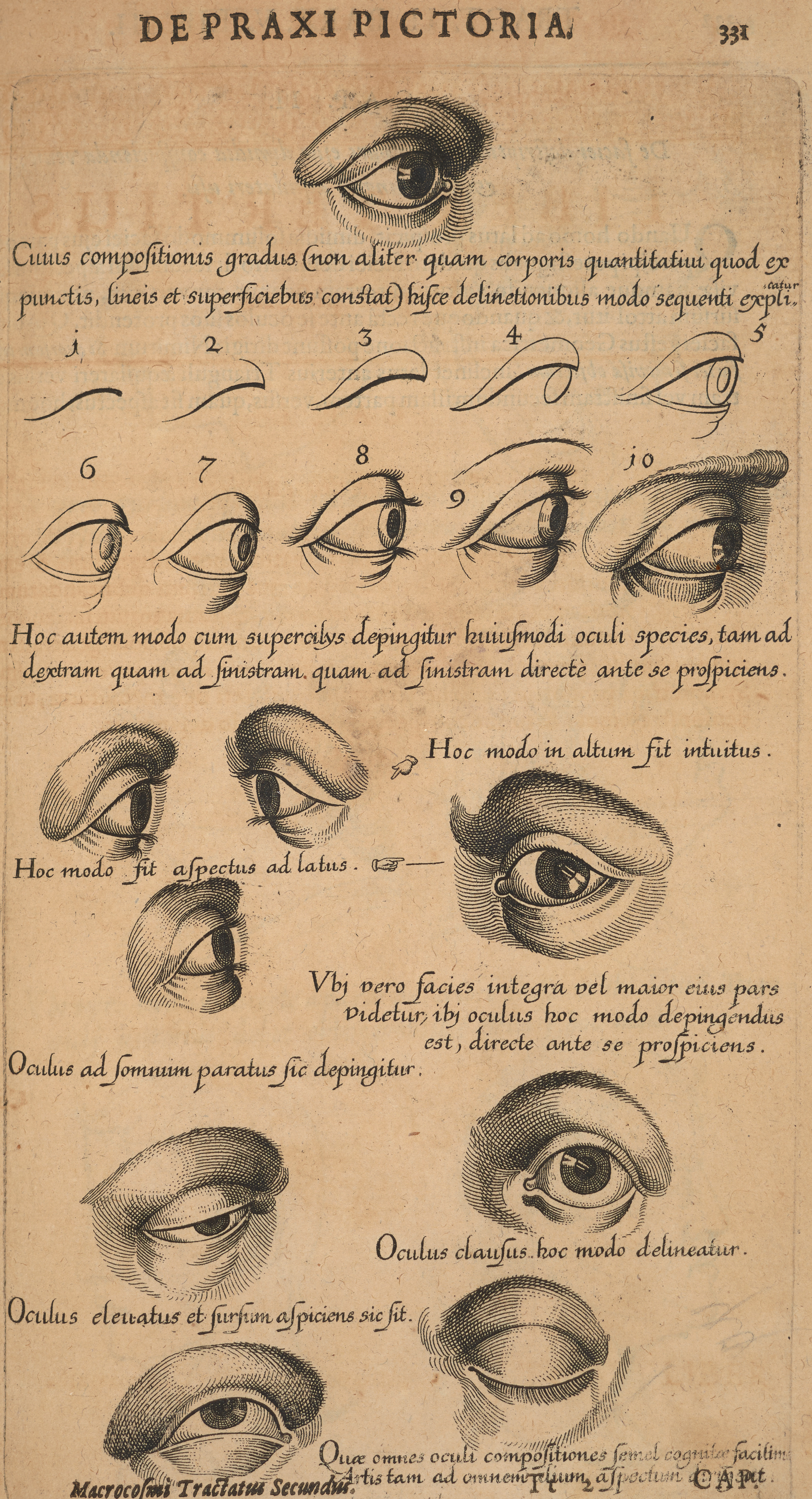
On the Practice of Drawing: Eyes
A drawing lesson in a book of the cosmos.
- Work
- from Utriusque Cosmi Historia
- Maker
- Robert Fludd; published by Johann Theodor de Bry
- Date
- 1618
- Source
- Published Oppenheim, 1617 · scan: Wikimedia Commons
Format
The full-resolution scan, color-managed to the source plate — yours to print, study, and explore.
Size
$29.00
The story
Rows of eyes run down the page, each one a stage further on, from a bare outline to a shaded, finished eye looking back. The heading reads De praxi pictoria, on the practice of painting. Robert Fludd's history of the two worlds did not stop at the heavens: its second treatise, on the arts that copy nature, taught arithmetic, music, surveying and drawing too, and this page is a plain drawing lesson. It is a good reminder that the people who drew the cosmos also had to learn to draw.
See it on your wall
The plate, in your home
On the Practice of Drawing: Eyes printed large and framed, hung in rooms like yours. Every edition ships ready to become the piece the room is built around.




About this reproduction
- A faithful reproduction of a public-domain plate — from Utriusque Cosmi Historia (1618), held by Published Oppenheim, 1617 · scan: Wikimedia Commons. The work was published before 1931 and is centuries out of copyright.
- Printed to order on 200gsm EMA matte art paper; framed pieces sit behind acrylic, no mat.
- Color-managed to the source scan; we correct nothing and invent nothing.
- Ships in 5–10 business days, rolled in a heavy-wall tube (framed pieces ship flat-packed).
- If it arrives less than perfect, we reprint or refund — your choice.
Why our plates cost more than a poster: we print from the highest-resolution scans available, at sizes where the engraving itself becomes visible — the emblem line, the letterpress bite, the registration of colour — on stock made to outlive its owner.